GET ALL THE LATEST NEWS IN THE WORLD.... sPorTS, eNtErtAiNmEnt AND more

Friday, 31 August 2012

ACCEPTANCE SPEECH OF H.E. JOHN DRAMANI MAHAMA, FLAGBEARER OF THE NATIONAL DEMOCRATIC CONGRESS (NDC)

John Mahama

  • Mr. Chairman
  • His Excellency, the Former President of the Republic of Ghana and Founder of the National Democratic Congress, Flt. Lt. (Rtd) Jerry John Rawlings
  • Members of the Council of Elders of the NDC
  • H.E. Vice-President Paa Kwesi Emissah-Arthur
  • The National, Regional and Constituency Executives of the NDC
  • Delegates at this Congress from all over Ghana
  • Members of the great NDC party here and who are watching us on television or listening to us on radio
  • Potential members of the NDC party who will be joining our great party
  • Executives of other political parties here present
  • Our friends from the media
  • Ladies and Gentlemen.
It is with profound humility and immense gratitude that I accept your nomination as the Presidential Candidate and Flagbearer to lead our great party, the National Democratic Congress for the 2012 Elections.
Mr. Chairman, permit me to dedicate this moment to the enduring legacy of one man, a man who put his entire life at the services of our dear nation and in deed of humanity; a man who toiled and served till his last breadth; a man whose life and death rekindled the very soul and spirit of our entire nation.  Ghana of old was receding into acrimonious decadence, but His Excellency John Evans Attah Mills resuscitated and revived our resolve to unite, both as a Party and as a Nation; a New, Cleansed Nation.  I dedicate my speech to him and his memory!
Let me further express my thanks to the historic legacy of the iconic, inspiring and charismatic founder, of our great party,  His Excellency Flight Lt Jerry John Rawlings.  He has inspired us all to remain steadfast in our belief that hard work and honesty shall set us free and liberate the inner energies that will transform this nation.
I will also like to thank the National Executive Committee, the various other committees and all the members of our great NDC party for ensuring that the management of the affairs of our party in the past trying weeks, including the organisation and management of this congress, have been intelligent, professional and seamless. To the Chairman, national, regional and constituency executives of this great Party, I salute you all;
To my old and trusted friend and comrade, Vice-President Paa Kwesi as we affectionately called him in Legon, our collective experience in the Aluta days has shown us the discipline of struggle and imbibed us with the humility to provide service in honesty to our people.

Most of all, I will like to thank you the delegates who travelled long distances, some throughout the night yesterday, to be here today to cast your vote to confirm me as your Flagbearer and to assure me of your prayers and support in the coming elections.
My dear wife and life partner – Lordina, you have accompanied me literally all my life on several challenging journeys from high school. I know you are poised to help steer the caravan further and inspire millions of young people as we collectively embark on the victory march.
My story as a farm boy from Bole in the Northern Region epitomises the promise of Ghana.  A country of equal opportunity, social justice and the pursuit of happiness by all, irrespective of class and privilege. I attended high school in Tamale, lived and worked in Tamale for a while after graduating; I served my professional terms in modesty; I represented my people in Parliament and I provided my stewardship at every level of human endeavour with humility and respect.  As I look across this mammoth congress, I see hope on the faces of every Ghanaian, both here and across our dear nation.  I see every Ghanaian living my story and collectively saying we shall make it, as a Nation, if we try.
It is this aspiration that has always set this country apart - that through hard work and sacrifice, each of us can pursue our individual dreams but still come together as one Ghanaian family, to ensure that the next generation can pursue their dreams as well.  We witnessed this incredible knitting of the fabric of unity a few weeks ago, and today, we will rank highest as the most united country in the world, if such an index were ever to be instituted.  In that respect, I salute our dear motherland, GHANA.
As I stand before you today, our nation Ghana is rated among one of the fastest growing economies in the World. We have recorded the most sustained and longest single digit inflation level in Ghana’s history.  In less than 4 years into our Better Ghana Agenda, the level of infrastructure development, access to social services and quality of life for ordinary people is unprecedented in Ghana’s history.  Our country is now accredited to be among the very first in Africa south of the Sahara to be in transition to middle-income status!  We are ranked as one of the highest and fastest growing in internet connectivity; we are ahead of most in soccer; our democracy and the institutions and citizens that sustain it will win gold medal awards if this was part of the Olympics; ladies and gentlemen, do NOT allow anyone to fool you, you are living in one of the greatest nations on this planet, and there is hope for more.
My fellow countrymen, challenges exist.  Poverty lingers on in some parts of our country; infrastructure deficiencies continue to constrain productivity gains; the delivery of social and economic services for ordinary Ghanaians is far less than optimal; the Ghanaian private sector needs further encouragement to translate their dedicated energies into transforming the economy to create durable jobs.  Happily, as we enter the threshold of our era of transformation, I see the same determination that fostered our renewed unity into one of resolve to open a new leaf.
Where our opponents see despair and despondency, we see incredible progress and hope for the future, millions of Ghanaians observe the same reality, and the international community attests to Ghana’s success story.  Where our opponents promise socio-economic transformation in the future, we know, and the international community attests, that Ghana’s transition to middle income has started, here and now!
So, I ask you this basic question: are these opponents living in the same country; if they do not recognize signs of transformation and advancement, how can they promise  to industrialise our country? Upon what foundation will they build?
I will shortly outline my vision for this vigorous, renewed effort, but suffice it to say that the monumental gains, in only 3 and half years, have laid a solid foundation for the onslaught on poverty, accelerating infrastructure development, deepening our decentralization and ensuring the effective participation of our citizens in governance, and also holding Government accountable.
To our Party, today is our day of sober reflection about two things: the first is unity among our ranks; and the second is organization.
Fellow leaders of the NDC, we have no option but to unite as a party, ensure victory in December and translate the huge gains made in the first four years of our administration into even more tangible benefits for Ghanaians. If we fail to do that from this moment on, we will be making a mistake for which future generations of NDC members may never forgive us.

What has always set the NDC apart has been our capacity to recognise our differences, openly confront one another when we have to, have our fights even in public, pursue our individual dreams, but still come together as one NDC family, to ensure that through hard work and sacrifice victory is won.

I stand here today to pledge that at anytime that this promise is in jeopardy, I will do everything in my power to restore it, so that future generations of the NDC will also achieve their dreams and draw from us the courage to keep the promise alive. I need for each of us the leaders of this party to subscribe to this pledge so that we can be assured a united party.

The greatest threat to our brothers and sisters in opposition is a united NDC; and yet, the greatest asset of our national endowment is unity. A united NDC is the most formidable election machine that this country has ever seen. And united we must, and united we will go to the polls come December 7.

My fellow Akatamansonians, I need to be assured of a united party for one reason. We need a resounding one-touch victory come December 7. We need a victory that will extract conceding speeches from the other candidates within minutes. We need a victory that conserves the resources of the nation from a second round of voting. We need a victory that will have no chance of going to the courts of law.

Above all, fellow Akatamansonians, I need to be assured of unity because I need as President to focus on the nation, even as you focus on the elections. On Tuesday, September the 4th, 2012, I will announce to the nation a number of policy initiatives that will both take us to the end of this year, and set out parameters for sustaining the gains of 4 years under NDC stewardship. We must not allow the electioneering campaign to sidetrack our resolve to maintain steady, robust and sustainable economic fundamentals; to promote job creation; to critically review and take urgent action in key social development and social service areas-health, education, electricity, water supply and sanitation; to re-dedicate attention to accelerated development of the deprived areas of Ghana, with priority on SADA and the Western Corridor; to enhanced social and environmental discipline and safety; and to improve good governance.

Fellow Akatamansonians, we have no other option than to lead this nation. We cannot allow the sweat, toil and sacrifices of President Rawlings, President Mills, all the NDC sympathisers who were victimised and imprisoned by our opponents, all those who died or were wounded or mishandled during the 2008 elections; and all other Akatamansonians to be in vain. We cannot afford to have another period of misrule by any other party at this time of our history. We cannot allow the robust economy that we have built in the last four years to go to waste. We cannot afford to miss the opportunity to translate the growing economy into years of prosperity for Ghanaians.
We must pledge to remain united. We must pledge to march forward together. We must pledge to keep the promise. We must pledge to hold on firmly, without wavering, through December 7 and unto a prosperous future for us all and for all Ghanaians.

For over 5 decades of our independent nationhood, our opponents have subscribed to that old, discredited philosophy - give more and more to those with the most and hope that prosperity trickles down to everyone else. At the core of their philosophy, they call this a Property-owning Democracy, but what it really means is - you're on your own. No house or meaningful property? Too bad. Born into poverty? Pull yourself up by your own bootstraps - even if you don't have shoes. You're on your own.
Well it's time for them to own their failure. It's time for us and over 20 million Ghanaians to hold onto our social democratic ideas and philosophy; ideas that liberated and built this nation while their fore-bearers opted to remain under the yoke of colonial rule for the foreseeable future.
Fellow Akatamansonians, your duty is to remain united and to bring everyone back into the fold. My duty is to continue to deliver development and progress to the nation so that we can win over the millions of floating voters. I will not let you down. You must not let me down.  This brings me to the second point: we must organize. The legendary Osegyefo Dr. Kwame Nkrumah said: organize, organize, organize!  Our own charismatic founder President Rawlings exemplified the most remarkable and practical manifestations of organization and leadership from the grassroots. 

As we congregate here, all our organizational assets are being re-activated; both our recently departed ancestors and our living elders have given their blessing; what is left is the resolve of our youth and members.

ARE YOU READY
ARE YOU READY
ARE YOU READY 
Thank you, God Bless you, and God Bless GHANA, our motherland

Thursday, 30 August 2012

White Dove Settles On Prez Mahama At NDC Congress


The sudden appearance of a white dove which settled for a while on the shoulders of the President during the Special Delegate’s Congress in Kumasi has been given different interpretations by some keen observers.

Whiles some said the dove which settled on the right shoulder of President John Dramani Mahama, during the event of the National Democratic Congress at the Baba Yara Sports Stadium in Kumasi, was a good omen which foretold a resounding victory for the party in the upcoming December Elections, others said the dove which flew in from nowhere and perched on the President and was later seen ambling about in front of the dais where the leadership was seated, was a mere superstition which held no special significance.

A couple of weeks ago, a similar incident occurred when a white dove sat on the vehicle of the wife of the late President Mills, Dr Mrs Naadu Mills, when her late husband’s remains was being carried to the burial site and many who witnessed the incident expressed the feeling that such things did have spiritual significance and should not be simply dismissed.

Middle-aged Madam Margaret Oteng, a trader at the stadium, said “the spirit of President Mills has come back to the President to imbue his successor with the spirit of courage to continue with his good work of peace and unity.”

Opanin Kwame Ohemeng, an NDC supporter, said in the Bible, the dove signifies the Holy Spirit, which Christians believe symbolizes truth, light and love.

He said the incident is also a reminder to President Mahama to espouse those similar virtues to unite the party and the people of Ghana for a peaceful poll in December.

Miriam Agyei, a 32- year old second-hand clothes seller at the Kumasi Central Market, however, expressed an entirely different view saying, “I don’t believe in these things they are just unfounded superstitions.”


Source: GNA

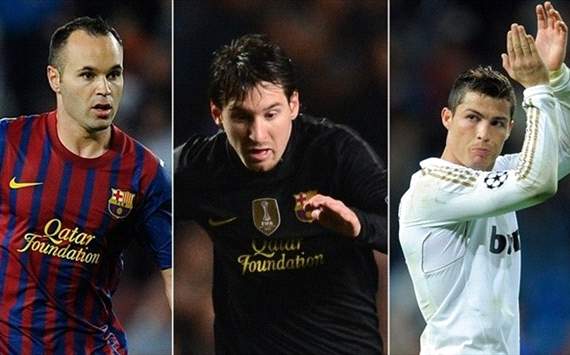
Iniesta wins Uefa best player award ahead of Ronaldo and Messi

Andres Iniesta, Lionel Messi , Cristiano Ronaldo


Spain midfielder Andres Iniesta has scooped Uefa's award for the best player in Europe over the last season ahead of Barcelona team-mate Lionel Messi and Real Madrid star Cristiano Ronaldo.
The 28-year-old shined as the Blaugrana finished second in La Liga and reached the semi-finals of the Champions League.
He also performed admirably as Spain retained their European Championship crown in Ukraine and Poland in the summer and was subsequently named the best player at the tournament.

And he has now scooped another award, pipping the Argentine and Portuguese forwards, despite their respective 73 and 60-goal campaigns.

"Without my team-mates at the Spanish national team and Barcelona I wouldn't have won this individual trophy," he commented.

His captain at club level, Carles Puyol, was quick to congratulate the Albacete-born schemer on his official Twitter page.

"Congratulations, Andres!! You deserve this."

Iniesta received 19 votes from the panel, while Messi and Ronaldo were both given the nod by 17 voters.

In last year's edition of the award, Messi was named as the best player in Europe, with fellow Barcelona star Xavi and Ronaldo finishing in second and third place respectively.

source:goal.com

UEFA Champions League Draw


Manchester City will face Real Madrid for the first time after being drawn against Jose Mourinho's side in the Champions League group stage.

City have the toughest group of all in Group D with the Spanish champions Real, Dutch league winners Ajax and German double-winners Borussia Dortmund all dangerous opponents.

Chelsea, the defending European champions, also have a tough-looking task in Group E along with Shakhtar Donetsk, Juventus and Nordsjaelland.

Manchester United and Arsenal have more straightforward groups. The Gunners are in Group B with Schalke, Olympiacos and Montpellier, while Sir Alex Ferguson's United will take on Braga, Galatasaray and CFR Cluj in Group H.

There are a couple of glamour ties in prospect for Celtic in Group G - Barcelona are in the group along with Benfica and Spartak Moscow.

The draw for the UEFA Champions League Group stages:

Group A: FC Porto, Dynamo Kiev, PSG, Dinamo Zagreb.

Group B: Arsenal, Schalke, Olympiacos, Montpellier.

Group C: AC Milan, Zenit St Petersburg, Anderlecht, Malaga.

Group D: Real Madrid, Manchester City, Ajax, Borussia Dortmund.

Group E: Chelsea, Shakhtar Donetsk, Juventus, FC Nordsjaelland.

Group F: Bayern Munich, Valencia, Lille, BATE.

Group G: Barcelona, Benfica, Spartak Moscow, Celtic.

Group H: Manchester United, Braga, Galatasaray, CFR Cluj.

First match days are 18 & 19 September 2012.


Source: sportsfever

Women And Smell...


I don’t know what I’ve been expecting all these years when it comes to my love below, but I think I had the perception that vaginas are supposed to smell like lillies. Or strawberries. Or pretty much anything that makes people smile or gives off a widely adored scent. However, mine doesn’t smell like that, and for years it made me self-conscious.

I think we’re all like that sometimes though. For instance, when we start our periods, we’re mortified at the possibility that we’re smelling like catfish instead of roses, and we worry that people who really aren’t paying us any kind of mind can pick up our less than fresh scent. Chances are, unless you’ve been working out all day while on your period and are dancing in front of folks, or passed on the opportunity to change your feminine products during the day, nobody but you can smell what you’re working with.

But for me, even when I wasn’t on my period, I was paranoid about what I smelled like. Before you try to play me, I know I didn’t smell like rancid cheese or something of that horrifying sort, but with all the Summer’s Eve ads and such telling us we’re supposed to smell like floral arrangements, I was wondering if I was as fresh as I could be. For instance, in college, as I experimented more sexually, I wasn’t as excited about my boyfriend’s choice to go down on me as most would be, because my mind wasn’t on him as much as it was on my lady parts. There came a point where I couldn’t wait for him to be done so I could stop feeling like I got caught with streaks in my underwear or something.

In an article for Women’s Health, sex educator Logan Levkoff stated that many women are self-conscious when they really don’t need to be: “We are overly sensitive and insecure about the smell of our vaginas. And we are far harder on it than any partner would be.” It was pointed out that women are so self-conscious about the smell their bodies make that many aren’t fully enjoying oral sex (“the prime gateway to orgasm”).

And that’s true about what men think of your scent. Unless you smell terrible, most men don’t find your scent to be anything but wonderful. Whenever I asked said boyfriends if I smelled any sort of way, they would say no, it just smelled like a vagina. Thanks, but that didn’t stop me from worrying. Going to the gynecologist was even a terribly uncomfortable thing, and not just because of the pap smear…

I bought Summer’s Eve and thought it was going to change things for the better, but in all honesty, aside from using it when finishing my cycle, these feminine washes messed with my natural odor and PH balance, only to make me smell a lot worse than I originally did. No matter what I tried or did, I was more and more uncomfortable about my lady bits than ever.

That was until I did some research and started having real conversations with other women, only to find that yes, vaginas do smell. They all have a smell, and in fact the smell is one that men are supposed to be biologically attracted to. I learned that I’m not the only one who gets paranoid about her vagina from time to time. Even today, when I asked a co-worker whether or not she ever worried about the way her lady parts smelled, she laughed a hearty, loud chuckle and eventually stopped to suprisingly say, “Yes.” It was nice to know that I wasn’t alone, and in fact, Eve Ensler, the woman behind the playwright behind The Vagina Monologues, cleared the air for me in a defiant, hilarious and honest bit about it all:

“My vagina doesn’t need to be cleaned up. It smells good already. Don’t try to decorate. Don’t believe him when he tells you it smells like rose petals when it’s supposed to smell like p***y. That’s what they’re doing — trying to clean it up, make it smell like bathroom spray or a garden. All those douche sprays — floral, berry, rain. I don’t want my p***y to smell like rain. All cleaned up like washing a fish after you cook it. I want to taste the fish. That’s why I ordered it.”

After finding that my partner paid absolutely no attention to any odors or scents (he stays down there by the way *winks*) and that, per the usual, I’m not the only person who ever wondered if my ish did or didn’t stank, I’ve become pretty comfortable with my vagina. I know how it smells on a daily basis, and the minute it doesn’t smell that way, I’ve decided that THAT’S when I need to worry. So no, it doesn’t smell like fruits and berries and poppies and roses, but as long as it smells healthy and smells like me, I’m good. Besides, I haven’t received any complaints yet…


Source: madamenoire

NPP Outdoors Its Manifesto With A Media Launch


The New Patriotic Party today out-doored its 2012 Manifesto to journalists at a special programme held at the International Press Centre in Accra.

The manifesto, TRANSFORMING LIVES, TRANSFORMING GHANA, is a 57-page document, which outlines how an Akufo-Addo presidency seeks to bring about socio-economic transformation in Ghana.

The party presented not only what it seeks to do but how it intends to achieve it and the impact it expects to have in transforming the lives of the people of Ghana.

There were eight presentations highlighting different aspects of what the party plans to do if elected into office at the December election. Particular attention was given to Education, Health, Housing, Infrastructure, Jobs and the Economy.

The manifesto has two major flagship policies, Education and Economic Transformation. This is based on the thinking of the Presidential Candidate, Nana Akufo-Addo, that, first, Ghana cannot continue being exporter of raw materials and importer of manufactured goods and expect to have the kind of advanced economy that can create a large pool of decent jobs with decent pay for the masses of the people. He has therefore made the issue of industrialization and adding value to the Ghanaian economy, from farming, through manufacturing to tourism, a must-do agenda for his government.

Secondly, Nana Akufo-Addo says Ghana cannot depend on its rich natural resources alone for development and that the current situation whereby over 75% of children who start school do not get up to secondary school education is dangerous, untenable and equal to consigning the youth of this country to a future of hopelessness and joblessness.

He has therefore made the issue of developing an educated and skilled workforce the key to building a free and fair society of opportunities and prosperity in Ghana. So to him, he will not accept as costly and unrealistic what is required to bring education and skills to the young people of Ghana.

Specifically, the NPP policy is to redefine basic education to mean that every Ghanaian child receives at least secondary education. This policy, which comes into full effect in 2014, will ensure that every JHS 3 pupil, after an assessment process in a revamped education system at the primary and JHS level, focusing on quality tuition, will gain automatic admission into secondary school.

In pursuit of this, the NPP has a two-track policy focus in education: (i) access to quality education at all levels (through the party’s ‘Teacher First’ programme) and (ii) free Secondary education (comprising all Senior High Schools and Technical and Vocational institutes).

Thus, for the party which introduced the Capitation Grant for free basic education, the NPP manifesto is now pledging to take it further by providing free compulsory education for all children in public schools from Kindergarten to Senior High School.

Professor Gyan Baffour, former deputy Minister of Finance in the Kufuor government, made the presentation on education and went to great lengths to explain how the new policy will be rolled out, when it will start, how much it will cost and how the NPP intends to achieve the twin project of providing access to free education and quality education, at the same time.

He took the time to explain how the party came about the GHC77.8 million additional cost for implementing free SHS for 2013. He said, the policy takes effect in September 2013, and in calculating it the party only, as it is normal, took into consideration the budgetary requirement for that year alone, which will involve just one term.

Free education will benefit all SHS and TVET students, those already in the system and new intakes, and the additional cost of that for boarding, lodging, and other fees will cost the taxpayer GHC74 million. In order to bring some form of equity, the NPP will also provide free meals for day students, as well. This will add another GHC3.79 million.

In preparation for the next academic year 2014-15, which will see all JHS students getting into secondary schools, an Akufo-Addo government will immediately spend some GHC213 million to expand facilities at SHS, including dormitories, classroom blocks and rehabilitation and expansion of other facilities, such as sports and laboratories.

Another GHC58 million will be spent on expanding and rehabilitating existing facilities at TVETs across the country.

The party also seeks to bring secondary school institutions closer to communities across the country, as a long-term project. In pursuit of this, GHC378.7 million will be allocated in 2013 for the establishment of 350 secondary schools within cluster schools across the country.

The NPP also anticipates day students having to travel some distance away from their homes to attend secondary school once that becomes compulsory. So, for 2013, GHC25 million will be spent to acquire new buses for students.

At the media launch, Dr. Mahamudu Bawumia, Akufo-Addo’s running mate showed how the economy can be managed under competent and dedicated hands. He spoke about the need to ensure value for money in negotiations and award of contracts and stabilizing the cedi to bring back both business and consumer confidence which are at an all time low, according to the Bank of Ghana’s own survey.

He spoke about the areas that the next NPP government will focus on in order to achieve the goal of adding value to our natural resources, creating linkages, encouraging the banks to fund the identified growth pillars, and freeing up the private sector to lead the transformation agenda and create jobs for the people.

He said the next government will have no choice but to name our streets, establish the now botched national identification system and work towards encouraging more businesses to be operated under the formal sector.

Ms Cecilia Abena Dapaah, MP for Bantama and former Deputy Minister for Water, Works and Housing, spoke on the new paradigm that the NPP seeks to introduce in the provision of housing.

The NPP has a programme to build 400,000 housing units within the next four years in partnership with the private sector. Many of the new homes will target the rental market, without requiring exorbitant advance payments form tenants.

The NPP housing policy will be targetting all levels of workers, from providing hostels and bedsits to street porters, hawkers, artisans etc., to providing flats and houses to nurses, teachers, civil servants, security personnel and others.

The party said it will begin by completing the over 5,000 units started by President Kufuor which the NDC has abandoned and set up a Housing Agency to undertake the coordination and implementation of a comprehensive housing policy that will see to land banks being acquired, new residential areas being built in order to ease the pressures of space in the city centres.

Dominic Nitiwul, MP for Bimbilla, spoke on Infrastructure and emphasized the superior record the NPP has against the NDC, especially in providing roads, access to water and electricity. For instance, while the NPP on an average built over 4,000km of new roads every year, the NDC has only added 1,000km to Ghana’s roads since 2009, he said.

Dr. Matthew Prempeh, MP for Manhyia spoke about how the NPP intends to tackle the culture in Ghana where little value is put on the lives of the people and Ghanaians suffer needless deaths. The NPP will resurrect the NHIS, which an Oxfam report last year said was all but dead, make it free for every child and pregnant mother to get medical care and expand the numbers of facilities, health workers and professionals. Mr. Isaac Osei, MP for Subin, made the presentation on Agriculture, Trade and Industry. The former Cocoa Board Chief Executive, spoke on the party’s plans to modernize agriculture as a pivot of the transformation agenda. He said the NPP knows that no transformation can succeed without agriculture and farmers being at the centre of it and the party was committed to improving the lives of farmers and adding value to their business.

Ms Gloria Akuffo, the former deputy Attorney General, made the presentation on Governance and made a commitment that the NPP in government will pass the Freedom of Information law. The strong session on anti-corruption measures drew applause from the journalists. The NPP will strengthen all anti-corruption organisations and reform the laws to make them bite better.

Ms Adwoa Safo, the aspiring MP for Dome-Kwabenya, made the presentation on the Youth and put herself right in the centre of the fight for the youth vote. She reminded the youth of Ghana that all the transformational policies of the NPP are for their wellbeing – education, skills and the economy, for instance, will help them gain access to good jobs with good pay.

Ms. Shirley Ayorkor Botchway, the former Deputy Foreign Minister and MP for Weija, made the presentation on Foreign Affairs and said Ghana can be trusted to play a leadership role in the agenda for regional integration under an Akufo-Addo presidency.

She said, economic diplomacy will be pursued in an intelligent, competent, confident and patriotic manner, different from what we are seeing now, to ensure that Ghana’s interest in the wider world is always protected and promoted.

Nana Akufo-Addo wrapped up the presentations by giving a clear indication on where he thought the battle lines of the election were going to be drawn and said the NPP was ready.

He gave his word to personally lead a campaign to restore dignity to the teaching profession. He also reiterated his personal pledge to fight corruption and appealed to the media to join him in that fight.

At the end of what was a well-choreographed ceremony, covered live on both radio and television, Nana Akufo-Addo ended with the inspiring words, ”the future is bright for Ghana”.

Read Full Manifesto Document Here >>


Source: akufoaddo2012.com

Wednesday, 29 August 2012

A Nation's Sex Strike For Democracy In Togo


In a time of global political combustion, with calls for democracy sparking mass demonstrations, self-immolations and civil wars, the women of the small African country of Togo might be the first to try to bring down a dictator by staging a sex strike.

The women, along with many men in Togo, have had enough of one-family rule. President Faure Gnassingbe took the presidency in 2005, shortly after the death of his father, who had held power for 38 years. The country has maintained a thin democratic façade, holding regular elections, but between father and son, the family has not relinquished power in four decades.

Opposition protests demanding changes to the electoral law ahead of the next elections have resulted in clashes with security forces and mass arrests. So on Saturday, in front of thousands of people at a rally in the capital of Lome, the female members of the opposition group Let's Save Togo announced the deployment of their new weapon.

Isabelle Ameganvi, head of the women's wing of the group, called on all Togolese women to "keep the gate of your 'motherland' locked up" for a week. If all goes according to plan, this is the week during which Togo's men are having time to think about the motherland and about their yearning for, well, democracy.

Organizers of the sex strike say they want to bring about the release of prisoners, and they want to motivate the men to take action against Gnassingbe. Ultimately, they want to see a true democratic change and the president to step down.

The idea of using sex for political objectives is not new. Women, who throughout history have found themselves at a disadvantage with men holding most of the power, have long known that men have a special vulnerability when it comes to sex. Withholding sex has been used to achieve political goals before.

As with every occasion when women have resorted to this tactic, the decision was reached after profound frustration with other methods. And it is a sign that women's power remains very limited that their best strategy is to pressure men to take action.

Some women say this tactic harms women by emphasizing their sexuality rather than their humanity. But Togo's activists say they are using their power wherever they can find it.

The idea of a sex strike has a history that goes all the way back to ancient Greece. In the play "Lysistrata," the women of Athens, fed up with the men's endless wars, decide to stop having sex with them until they put an end to the Pelopponesian War. The comedy was performed before Athenian audiences exactly 2,500 years ago.

Interestingly, in the play by Aristophanes, the women do more than withhold sex. They also take over the Parthenon, where the city holds the treasury that funds the war, and they fight to hold on.

It may take more than sex to persuade men to do the right thing, but "Lysistrata"-inspired actions have an illustrious and possibly successful track record.

In the countless times when women have launched sex strikes, it's impossible to know whether it was the lack of sex that ultimately produced the desired outcomes, because by the time women opted to brandish this weapon, they had tried many other ways. And it is also impossible to know just how thoroughly each strike was implemented. Or how many men resorted to sexual violence to break the strike.

Still, there are some interesting examples of women achieving their objectives -- which, incidentally, always seem to benefit society at large, not just women -- after the sex strike was called. Whether one thing produced the other is a subject of debate.

The clearest case of success took place in the Colombian town of Barbacoas, where last year women launched their "crossed legs strike" to demand construction of a road. They would not have sex, they vowed, until the men managed to get a road built so that it wouldn't take 10 hours to reach the provincial capital just 35 miles away.

Moved by the men's unimaginable suffering, the government agreed to build the road.

A few years earlier, also in Colombia, the wives and girlfriends of gang members in the embattled city of Pereira said they would keep their legs crossed unless the men stopped the violence that had killed nearly 500 people. The murder rate reportedly dropped by 26.5%.

But it wasn't ancient Greece or South America or a recent sex strike in the Philippines that inspired the Togolese pro-democracy activists. It was the amazing story of Liberia that gave them cause for optimism.

In 2003, the Liberian people had endured 14 years of a brutal civil war that had torn the country apart. The leaders of the Women of Liberia Mass Action for Peace organized a series of nonviolent actions, including a sex strike, demanding an end to the war. The group's leader, Leymah Gbowe, later won the Nobel Peace Prize, sharing with Ellen Johnson-Sirleaf, another Liberian woman who was about to make history.

Again, nobody knows just how important a role the no-sex portion of the protests played. But before the year was over, the parties to the conflict signed a peace deal ending the war and laying the groundwork for democratic elections.

When Liberians went to the polls, the majority voted for Johnson-Sirleaf, the first woman elected president in Africa's history.

Now that is a success story, because once women hold real political power, they no longer need to resort to sex strikes and other indirect means to express their views and obtain results. In the end, it's about giving all citizens, including women, a fair say in the political process. That's the ultimate goal in the struggle for true democracy.


Source: CNN

Tuesday, 28 August 2012

Al-Qaeda Plots Fresh Attacks On Ghana, Nigeria

Osama Bin Laden, founder of Al-Qaeda


As the country struggles to curb the violent activities of the Islamic fundamentalist sect, Boko Haram, international intelligence agencies have uncovered plans by al-Qaeda, to launch fresh attacks on Nigeria, Ghana and two other African countries.

Al-Qaeda, which was founded by the late Osama bin Laden, has launched attacks all over the world.

Investigations by SUNDAY PUNCH authoritatively showed that the targeted countries were receiving help from Western nations on how to prevent the onslaught.

However, it was not clear if the attacks would be launched by al-Qaeda in the Maghreb or the main terrorist organisation in the country.

The Deputy Force Public Relations Officer, Mr. Frank Mba, confirmed the al-Qaeda plot to our correspondent.

Mba, however, noted that such threats were received in the past, and added that security agencies were determined to ensure the group’s plan did not succeed.

According to him, the police are receiving immense support from developed countries that have counter- terrorism expertise.

Mba said, “That al-Qaeda and similar groups want to attack some certain countries is not new. As security operatives, we treat information at our disposal with uttermost care. We test their veracity and analyse them.

“Here in Nigeria, we stop most of the domestic attacks before they take place. We defuse more bombs than they detonate. We save thousands of lives daily but we do this discretely and quietly.

“More than ever, we have so much support from the international community. We are getting help from both ECOWAS and western countries. We are doing our best with the resources we have and we will continue to do so.

“We have stepped up security everywhere but we won’t disclose how we are doing that and the specifics of our mechanisms.

“I want to assure Nigerians and the international community that government is irrevocably committed to its mandate of providing adequate security in the country.”

Ghana, another country on the radar of al-Qaeda, last Tuesday stepped up security at its Kotoka International Airport, Accra, with heavy deployment of soldiers, who frisked passengers using metal detectors.

Armed troops are not a regular feature in Kotota and Ghanaians described the movement of troops as strange.

On Tuesday, Daily Guide, a newspaper in Ghana, had reported that, “Nigeria, three others are said to be on the radar of the terrorist group. Ghana is also said to be on a hit list of an international terrorist group, leading to deployment of soldiers at the Kotoka International Airport, Accra.

“It was learnt that the action of the military was informed by international intelligence fed to Ghana that the country was one of four others being targeted by terrorists for bombing. The presence of the soldiers is therefore a national security response to the alert, a source said.”

When the newspaper contacted Ghana’s Director of the Armed Forces Public Relations Directorate, Col. Mbawine Atintande, he reportedly explained that “there are only a few military policemen at the (airport) place.”

As to whether the operation was a response to certain international threat, Akintande said he would find out.

Just on August 3, 2012, the Foreign and Commonwealth Office of the United Kingdom warned travellers to Ghana that there was an “underlying threat from terrorism” in the country.

“Attacks could be indiscriminate, including in places visited by expatriates and foreign travellers,” it said.

Al-Qaeda‘s foot prints abound in Nigerian as it has cells in the northern part of the country and had also claimed responsibility for some terrorist activities.

In April, the State Security Service arrested Mohammed Ashafa said to be al-Qaeda linkman with a terror group in Nigeria.

Ashafa was reportedly apprehended by the Pakistani government through the National Intelligence Agency and handed over to the Federal Government for prosecution.

When he was arraigned at the Federal High Court, the SSS told the court that the accused person facilitated terrorist exchange programmes between al-Qaeda and its allies in the country.

The intelligence agency further said its investigations showed that Ashafa was allegedly the second in command to one Adnan Ibrahim, who was said to be the Resident al-Qaeda chief in West Africa, but based in Kano.

Also, in May, al-Qaeda in the Maghreb claimed responsibility for the murder of a German, Edgar Raupach, in Kano.

Raupach was killed by his abductors when security forces tried to free him during a rescue operation.

A Briton, Christopher McManus, and an Italian, Franco Lamolinara suffered similar fate in March.


Via Punch Newspaper, Lagos

SHOCKING: University LADY Infects 322 MEN With HIV/AIDs


Tongues are wagging in Nairobi, Kenya from a text message a lady student in the University of Nairobi forwarded to a colleague.

It read: “I am a student and I am HIV-positive. I swore I would spread the thing because I got infected during my first experience. I have slept with 322 guys in my campus and two outside. I wanted to infect 2,500 people but the guilt is now killing me.”

This shocking report comes barely two months after another female student at Moi University released a list of 90 guys and pinned it on a campus notice board claiming she had infected (or at least deliberately tried to infect) all of them with the virus. In the list were two names of prominent politicians.

The female student is bitter because she was infected on her first attempt at sex. More than ever before, sexual immorality, substance abuse and criminal acts have become the new nightmare among students in local universities.

In fact, academic excellence has become secondary to the vices. Whatever it takes, students will go to any length to ensure that they enjoy a luxurious lifestyle and every good thing life brings their way.


Source: highstreetmail.com

Monday, 27 August 2012

Mistakes Women Make Balancing Friends and Boyfriends


It happens time and time again, your friend doesn’t get along with your boyfriend or suddenly so many of your friends disappear when you get a new boyfriend. Yes, relationships can sometimes destroy or end some of your greatest friendships. But whose fault is it? The girl with the new man or the reactions of her friends when she gets the man? It can easily be a combination of both. Let’s have a look at some mistakes that women make when dealing with the new man in their life, whether it’s your man or the friend’s man. Here’s how relationships can destroy friendships:

Assuming your friends are jealous

“She’s just jealous!”…Let’s be honest, we’ve all probably said this before. This is probably the number one problem that leads to the destruction of friendship. Using jealousy as an excuse to be inconsiderate of your friend’s feelings or not listen to what they have to say is really just an excuse to continue swooning over your man. Your friends maybe genuinely concerned for your well-being or genuinely concerned about your friendship. Yes, it is possible that your friend is jealous, but it is also possible that she is NOT jealous. Don’t let this be an excuse to ignore the real problems.

Expecting everything to be the same

Time to point the finger at the friends on this one…this has got to be one of the most teenaged mistakes that friends make, but believe it or not, women still continue to do it even when they get older. They somehow expect their friend with the new boo to still spend as much time with them. Nothing in life ever stays the same…people change and grow in many different ways. People always accept these changes when it comes to someone getting a new job, living further away or just plain growing up. Why do you expect relationships to be any different?

Replacing your friends with your boo

You’ve been friends for years, and what does your girl do? Toss you aside like a rag doll for some guy she’s only known for a few months. A lot of us definitely know what this feels like. What makes this worse is that the more you try to confront her about this, the more she continues to run to her man. In cases like this, she is seriously just being a bad friend. You probably won’t like the resolution to this one… but in cases like this, sometimes it’s just not worth trying to repair. Your man should never be a replacement for your friends and if your friend can’t see this, then she probably doesn’t value your friendship enough.

Assuming your friends will always be there.

This one is almost like the last one…except in this case it doesn’t start out with negative intent. It’s one of those things where many small things accumulate into something huge. It’s been a while…you’re thinking should I have lunch with the ladies today? No, you say, “I can have lunch with them next time, I’m better off having my man over for a nice home cooked meal.” The ladies are going out tonight, but you say “but they do that every Friday night, so I’m gonna go see my boo instead.” It might even be that you’re having friendship drama, so you decide, I’d rather go chill with my man than deal with all the drama. Is this the right decision? WRONG! You can’t keep putting your friends at the bottom of your priority list. First of all, think about how this will make them feel. Second of all, this works both ways…who are you going to run to when you have problems with your boyfriend? You’ll be lucky if they’re even still there!

Never inviting the boyfriend to come along

Like any normal female, no one wants your friend’s man ruining your “girls night,” but come on ladies, you have to be endearing and inviting to him too. Just because you don’t want him to tag along on girls night, that doesn’t mean that you can’t try a dinner night or some other special event. Making sure to sometimes invite both of them will not only make the boyfriend more accepting of you as her friends, but she will also be more appreciative of you as a friend knowing she can share important aspects of her life with you.


Source: madamenoire

Wednesday, 22 August 2012

President Mahama ‘electrifies’ Ho


The Volta Regional capital, Ho, on Tuesday became alive following the arrival of President John Dramani Mahama in the town to thank people in the Region for showing love and sympathy to the government on the demise of President John Evans Atta Mills.

By midday, the Ho Jubilee Park was crammed with people awaiting the arrival of the President.

Economic activities virtually came to a standstill around 1300 hours as many taxi drivers joined the enthusiastic crowd and parked their cars at the Centre for National Culture yard.

Music and cultural performances by various drumming groups and cultural troops entertained the crowd which started gathering at 0900 hours.

Some chiefs were reported to have arrived at 1000 hours.

The music and performances reached a crescendo few minutes to 1600 hours when there were signs of the President approaching the Park amidst loud shouts and ear-piercing noise.

His arrival at the Park further electrified the grounds with everybody including “old ladies” and children trying to catch glimpse at the President in all black apparel.

The President acknowledged cheers from the heavy crowd, greeted the chiefs and went for his seat at the dais.

In a short address, President Mahama said, “Though I know this is the World Bank of the NDC, I did not expect such a gargantuan crowd.”

He apologized for arriving late and explained that he had to stop in every community from Sogakope to Ho to address the people because they blocked the road insisting to hear from him.

President Mahama expressed gratitude to people in the Region for the role they played in the death and burial of President Mills.

He assured the Region that all projects started by the Mills’ Administration would be completed.

Togbe Afede XIV, President of the Volta Regional House, thanked President Mahama for being appreciative and wished him well.

Mr Henry Ford Kamel, Volta Regional Minister, assured President Mahama of the support of the Region in realizing the “Better Ghana Agenda” started by the late President Mills.


Source: GNA

FULL SPEECH By Nana Addo At IEA Presidential Debate

Nana Addo


SPEECH DELIVERED BY NANA ADDO DANKWA AKUFO-ADDO, 2012
PRESIDENTIAL CANDIDATE OF THE NEW PATRIOTIC PARTY AT THE
EVENING ENCOUNTER ORGANISED BY THE INSTITUTE OF ECONOMICAFFAIRS ON THE 21ST OF AUGUST 2012

Chairperson, distinguished ladies and gentlemen, friends from the media, fellow Ghanaians, good evening.

This event was to have taken place two weeks ago, but was postponed at my request when President Mills passed away. May he rest in perfect peace.

Ghanaians should be proud that together we are building a democratic state, a Ghana being governed by the rule of law. We have just gone through a unique period in our history, dealing with the death in office of a sitting President. When put to the test, our democratic institutions rose to the occasion. The transfer of the Presidency was peaceful, smooth and constitutional and we should all be encouraged by the way the system worked. It strengthens those of us who have fought all our lives for democracy to flourish in Ghana, for it shows that constitutional democracy is the best form of governance for our beloved nation. We must cherish and protect these precious democratic values, which form the basis for the unity and progress of our country. We may have our differences, but what joins us together is more important. We are One Ghana and I am totally committed to working to ensure peace and unity for the Ghana project. I congratulate our new President and new Vice President on their assumption of office and wish them well in their brief, caretaker role. Their most important responsibility to Ghana is to ensure that we have a peaceful, free and fair election in December. Ghanaians expect nothing less.

My party and I are totally devoted to Ghana’s peace and stability, as we have always been. We, famously, demonstrated this in 2008 when, despite the narrowest of losing margins, we did nothing to jeopardise the stability of the nation and lived up to my pledge of not allowing a single drop of Ghanaian blood to be shed. I pray to God that all other stakeholders, especially the Electoral Commission, the ruling party and the security agencies, also make a genuine commitment to work towards a peaceful election, one that is free from fraud, intimidation, harassment and violence.

I thank the IEA for organising this event and commend them on their continuing commitment to the development of democracy in our country. I welcome this opportunity to talk about my party’s programmes for the December elections.

Over the last 2 years, I’ve been going around the country on my various tours, meeting Ghanaians in their homes, workplaces, farms, markets, lorry stations, at organised functions and sometimes at unscheduled stops; and I have heard their stories and seen their conditions. I read the numerous comments on my facebook page, and in our newspapers, and hear comments on radio and television.

What I see, hear and read makes me more and more convinced that we have to change the way we do things and transform our economy into a new one – a new economy that will help us give our children good education, create jobs, provide good healthcare, feed ourselves adequately, and give every Ghanaian an opportunity for a good life.

I recall the sad story of a 17 year-old boy in Akwasiho, in Abetifi, in the Eastern Region, who said he dropped out of school because his parents couldn’t pay his senior high school education. This particular boy’s story stays with me mostly because of the sound of desperation in his voice. There are thousands and thousands like him. I met Kwame Osei, in Suproano in the AnhwiasoBekwai District, Western Region. He is a cocoa farmer and at age 42, he should be one of our success stories. But he said, “the cost of fertilizer and pesticides, coupled with the collapse of mass spraying, is making life very hard.” At the Sango Beach, here in Accra, fishermen were downhearted and frustrated. Their major complaints were about the increasing cost of fishing equipment and inputs. Outboard motors that cost GH¢2,900 in 2008 now cost GH¢8,000 - in single digit inflation Ghana.

Esinam told me in Vakpo, in the Volta Region, that her problem was the collapsing National Health Insurance Scheme. She said, “NHIS egblen!” Young men and women everywhere I go are crying for jobs, and they are desperate for someone to give them hope for a meaningful future.

The black market trade in foreign currency is back as the cedi continues to fall against all major currencies. Business people complain of the rising cost of business, poor sales, lack of credit and support to grow their businesses.

Ghanaians are clearly unhappy and dissatisfied with the conditions of their lives. And, yet, the town criers of NDC propaganda tell us we are living today in better times.

My life has been about service to people. This has been my driving force as a lawyer, as a political activist against military rule, as a campaigner for human rights and democracy, as a Member of Parliament, as Attorney General and as Minister for Foreign Affairs. In between these endeavours, I have also been in business and done reasonably well. Twenty years ago, I was excited by the potential of mobile telephones and played a pioneering role in bringing the first mobile telephony company, Mobitel, to Ghana, which started an industry that has transformed the lives of millions of Ghanaians. As a lawyer, I mentored many young people who are now among the leading lawyers of our country. It is these various roles and experiences that I believe, in all humility, have prepared me for the serious job of the Presidency.

My goal is to provide transformational leadership and help build a prosperous society, which creates opportunities for all its citizens, rewards creativity and enterprise, honesty and hard work, a society where there is discipline and fairness, where people go about their lives in a free and responsible manner, a society where there are safety nets for the vulnerable and decent retirement for the elderly, an open society protected by well-resourced and motivated security services and where the rule of law works.

For this to happen, Ghana needs effective leadership, leadership which is honest, competent and determined to deliver. A leadership of conviction – which is committed to fighting corruption and dedicated to the welfare and wellbeing of the Ghanaian. It is clear that corruption has become rampant in these last few years, robbing us of much needed resources for our development. I am determined to fight corruption aggressively, and I can do so, because I am not corrupt, have never been corrupt, and will demand the same of my team. Accountability and transparency are the hallmarks of good governance. Ghana needs this, Ghana deserves this and I, Nana AddoDankwaAkufo-Addo, pledge to deliver this to the good people of Ghana.

The people of this country have to be healthy, if we are to make any meaningful progress in nation-building. The last NPP government introduced the National Health Insurance Scheme to remove the constant fear of falling ill under the inhumane Cash & Carry system. It has been painful to watch the NDC government try its best to collapse the NHIS, whilst struggling to implement their unrealistic one-time premium promise. Today, the fear of getting sick is back. The NHIS has been degraded and Cash & Carry is back.

Fellow citizens, we will revive and restore confidence in the NHIS. Our goal is to achieve universal coverage of the NHIS for all Ghanaians. The NPP will spend more on public-health education and primary healthcare.

We shall expand health facilities and increase the training of health workers; we have done it before, increasing it by seven-fold in just six years. Our priority is to train our medical professionals locally. Recently, a scheme, operated by then Vice President Mahama, sent 250 people to Cuba to be trained as doctors and para-medics, at a cost of GH¢106,000 each. We could have trained them at GH¢30,000 each, according to the Ghana Medical Association. We will rather invest in our medical schools to train a lot more doctors here in Ghana.

If good health is basic to our survival, good education is critical to our development. Education creates social mobility; Market women and fishermen, farmers and traders, taxi drivers and artisans, hawkers and kayayei, and, indeed, every mother and father, all hope that education will help their children escape poverty and give them access to a good life.

Education is at the heart of the NPP programme. We cannot transform the economy and the country without transforming the knowledge and skills of our people. Every child, rich or poor, able-bodied or disabled, deserves a good education.

Currently, at every stage of education, our children are falling out of the system. To our eternal shame, some children born in this country never even make it to a classroom. Then, of the numbers that do start school, over 60 per cent of them do not make it to secondary school. The situation has become significantly worse over the last three years, with even fewer children (47% as against 62% in 2008) passing the BECE. In some villages, not a single child passes the exam. Every year, more than 150,000 young Ghanaians leave school at JHS level without any opportunities for further education or training. This is dangerous!

To change this situation, we will redefine basic education and make it compulsory from Kindergarten to Senior High School. To ensure that no child is denied access to secondary education, we will remove the biggest obstacles that currently stand in their way: cost and access. In addition to tuition and other costs already borne by government, admission, library, computer, science centre and examination fees will all be free. So will boarding, feeding and entertainment fees, along with textbooks and utilities. In order to ensure equity, day students will also be fed at school free of charge. Free secondary school education will cover Technical and Vocational institutions.

I know this will be expensive. But, as the Ewe saying has it, “you cook important foods in important pots.” The cost of providing free secondary school education will be cheaper than the cost of the current alternative of a largely uneducated and unskilled workforce that retards our development. Leadership is about choices – I will choose to invest in the future of our youth and of our country.

Fellow citizens, I know numbers can be boring, but these are important numbers. The additional cost of providing Free Senior High School will be around 1% of Ghana’s GDP. The cost of providing free secondary school education, which includes tuition, boarding, feeding and all the other charges for the 2013-2014 academic year, is estimated at 0.1% of our GDP. This translates into some GH¢78 million. We have made provision for a major increase in enrollment as a result of admitting all JHS students into SHS in 2014-2015. We expect the cost to rise to GH¢288 million (0.3% of GDP) in that academic year and increase to GH¢774 million in 2015-2016 (0.7% of GDP). Additional expenditure on more teachers, infrastructure for schools, including expanding and rehabilitating existing infrastructure, and establishing cluster schools in areas where there are no Senior High Schools, will bring the total cost to GH¢755 million (0.9% of GDP) in 2013 and rise to GH¢1.45 billion (1.3% of GDP) in 2016. Providing free secondary education will increase the total educational expenditure from the 4.1% of GDP in 2012 to 5.8% by 2016, a figure which is still below the UNESCO minimum of 6%. I am prepared to go beyond that in order to improve quality at all levels – Primary, JHS, SHS, and Tertiary.

Countries that have taken deliberate, successful steps to improve their economies have spent substantial amounts of their national income on education. For example, in 1960, during its post-war transformation, Japan spent 21.4% of its GDP on education and Malaysia, at an equivalent period in 1990, spent 15.3% of its GDP. On our continent, a number of African countries are doing better than us. Kenya spends 6.7% of its GDP on education, South Africa 6% and even tiny Lesotho puts us to shame by spending 13% of its GDP on education. We may be able to beat them at football, but not in education.

Let me put this into context; the NDC admits to paying out some GH¢640 million, equivalent to 1.4% of Ghana's 2010 GDP, as judgement debts. Are we telling parents and their children that a Ghana that can afford to spend 1.4% of its income on judgement debts cannot afford to spend an additional 1.3% of its income on giving its children free secondary education?

We know how to fund it. A percentage of the oil revenues allocated to the Ghana National Petroleum Company, and for the funding of the budget, as well as a greater percentage from GETFund, will be used to finance the programme.

These plans can only work with the enthusiastic support of a well-trained and motivated teaching workforce. We do not have enough teachers and many are not happy with their lot. Last year, the Minister for Education said there was a 60,000-teacher deficit in the country. The NPP will attract, train and retain young professionals into the teaching profession. We will make it easier for teachers to upgrade their skills, improve their status and provide them with incentives . For example, any teacher with 10 or more years of service will be eligible for a mortgage scheme, supported by government, for a home anywhere in the country. We shall endeavour to make teaching in the rural areas, in particular, less stressful by providing accommodation and transportation. It is obvious that the scope of our modern lives has placed extra responsibilities on our teachers. With most families now made up of both parents going out to work, children spend much longer periods at school and teachers have to see to their moral as well as academic upbringing. Society must recognise this and accord our teachers the necessary incentives. That is why an Akufo-Addo presidency, God-willing, will introduce a Teacher First policy to give teachers the recognition they deserve. Free education must be achieved, hand in hand, with quality education and we shall work with the religious bodies to ensure equal weight is attached to the moral upbringing of our children. We also acknowledge the important work the private schools are doing, and we will work with them to improve delivery.

Our young people need skills for the job market. We need apprenticeship schemes that teach skills and guarantee quality. We will borrow from the experiences of countries that have industrialised with the skills of artisans. On a recent trip to Germany, I explored the possibilities of collaboration so that we can bring home the apprenticeship models, which have helped Germany make quality products that are famed around the world.

The 2008 Education Act made provisions for apprenticeship schemes. We will implement them. Technical and Vocational Institutions will be increased, equipped and enhanced to help fill the critical skills gap required to industrialise Ghana. At the higher level, education must produce technical, professional and managerial personnel to drive Ghana’s industrialisation and transformation.

We shall formalise collaboration between government, the private sector, teachers’ associations and institutions of higher learning, including polytechnics, for manpower planning and needs and, thereby, address this new, unwelcome phenomenon of rising levels of graduate unemployment. We will put greater emphasis on research and development, science and technology, to provide the nuts and bolts for the new economy.

The number of people, especially young people, without jobs in our country is frightening. Our much-touted economic growth has not translated into jobs and incomes for the people beyond the government propaganda of creating 1.7 million ghost jobs, which even the sector Minister could not find.

The hard truth is that the current size and structure of our economy is not big enough to provide the jobs that are needed. If we want a different result, then we have to do things differently, and we have to do them urgently. We have to make a deliberate effort to move on from the Guggisberg, raw material-exporting economy to a new economy that can deliver prosperity for our people. We will encourage importers and Ghanaians abroad to shift from bringing in finished products to bringing in the know-how, tools and capital inputs that will enable us produce finished goods right here in Ghana. The long-term solution for the stability of our cedi is industrialisation.

Right now, if you go to the market and just look, the absurdity of our situation is bound to hit you. We allow our fruits to rot and import fruit juice. My government, God willing, will give new impetus to value-addition. In the next two decades, the population of West Africa is estimated to reach some 500 million people. The NPP is fully committed to the ECOWAS integration project, for Ghana has the potential to be at the centre of economic activities for this vast regional market. My message to the youth of today, is, if we start preparing now, by transforming our education, our skill-sets and our economy, we will transform forever your lives and that of generations yet to come.

We have to modernise our agriculture and process our agricultural products. The models implemented by the Millennium Development Authority (MiDA), which we formulated when we were in government, have been shown to work. We will use them to end the disgraceful situation of food crop farmers being amongst the poorest segment of the population. A major plank of our agricultural policy will be to achieve food self-sufficiency. Both commercial and small-scale farmers will be supported to improve their output and develop their business.

The value of the minerals in our country, including salt, is estimated to be in excess of US$1 trillion. We have developed plans to add value to them. We will attract the necessary capital to mine our bauxite to build a multi-billion dollar integrated aluminium industry, as envisaged by the Kufuor government. We will use a similar model to exploit our iron ore deposits and build urgently a new iron and steel industry, which can also process West African ore currently being shipped to Europe for refining.

Presently, our oil refinery is not working. The NDC government is wilfully starving it only to import finished products. The NPP will change this. We will use the oil & gas find to build a strong petrochemical industry in Ghana, using both private and public financing, and create linkages with other businesses to turn Ghana into a centre for light industry in our region.

I believe that, beyond a competent, incorruptible leadership, the best instrument for achieving economic transformation is the private sector. We shall vigorously assist all our enterprises, especially small and medium scale ones, both in the formal and informal sectors, to grow – by helping them gain access to credit, technology and markets. Much greater attention will be paid to indigenous and local businesses to expand and create jobs for our young men and women. Ghanaian businesses will play the lead role in public procurement. The tax and tariff systems will be restructured to promote growth in the private sector. Policies will be introduced that will encourage banks to support the transformation agenda. We will strengthen the regulatory bodies to do the job of protecting consumers and improving standards. We will empower Ghanaians to do the job of transforming Ghana. We will make Ghana the place to do business, and make businesses in Ghana globally competitive. We shall forge a strong partnership with organised labour to achieve this. This is how we will create the hundreds of thousands of jobs for which the young people of our country are yearning. This is the only way to break the hand to mouth existence and free our people to aspire to greater heights. We can do it.


All of this requires a support infrastructure. Power cuts, lack of water, inadequate roads and transport, bad drainage and sanitation all affect business, frustrate lives and hold us back.
To accelerate our development, spending on infrastructure over the next decade will average some GH¢14 billion a year. We will do this by managing government resources and projects efficiently and attracting substantial capital from the private sector – in public-private partnership initiatives. Our infrastructure programme includes the development of roads, water supplies, sanitation, railways, ports, airports, and our plan to triple the irrigation of arable land and to complete a nationwide fibre optic backbone to facilitate effective and efficient ICT access. Critical to all this will be a dramatic expansion and supply of reliable power to support the transformation agenda.

Let me, in closing, mention the problem of housing. We have to resolve the appalling accommodation situation where over 50 per cent of Ghanaians live in sub-standard houses, deprived inner city dwellings, uncompleted houses, containers, kiosks, pavements and other unsuitable structures and the majority of tenants face the payment of huge advance rents especially in our cities. I will commit my government to complete the affordable housing project that was started by the Kufuor government and abandoned by the NDC. With the private sector, we will build more decent, affordable homes for working Ghanaians. They would range from hostels and bedsits to flats and houses.

Chairperson, this has been a summary of a few of the essential things that an NPP government, under my leadership, will do to improve people’s lives. Be assured that we will stabilise the sinking cedi, bring back business confidence and make investing in Ghana attractive to both local and foreign investors. We have spent time getting our plans right. Doubtless that must account for how the original theme of our manifesto, ‘PEOPLE MATTER, YOU MATTER’, was pinched by our opponents…. But I take the view that imitation is the greatest form of flattery and we wish them well.

I have a team, a dynamic and competent team, to implement plans designed to transform the lives of our people and develop in Ghana, a free, democratic, modern African state – one that can hold its own in a competitive world. I am privileged to have a deep pool of talent of men and women in the NPP to draw from, as well as from the broad spectrum of Ghanaian talent, home and abroad, to turn the dreams of freedom and prosperity of our forefathers into reality.

We have a clear vision of where we want to take Ghana and a detailed road map of how to get there. But in order to make the journey we, humbly, need you, fellow citizens and fellow Ghanaians, to make a decisive choice on December 7th and give us your mandate. Together, we will transform Ghana, and use all the blessings that the Almighty has bestowed on us to bring prosperity to our people and nation.

I do not underestimate the challenges we face in trying to achieve these goals, especially since many of you do not trust politicians, because of the many broken promises. But, I want you, the Ghanaian people, to give me the opportunity to serve you differently. I want you to trust me. I am no stranger to you. I have stood with you all my adult life, fighting for our individual and collective rights. I am proud of what we have so far achieved in political and civil rights. The next struggle is for economic progress: transforming our economy for opportunities and prosperity for us all, regardless of the circumstances of our birth. I am strong in my conviction and confident that we can do it. I know we are capable. Let us be strong and courageous. God did not put us on this rich land to be poor. It is bad leadership that makes us poor. So let us change now! and move Ghana forward together. I believe in you. I believe in the can-do spirit of Ghanaians. I believe in Ghana. And, above all, I believe in God.

God bless you

God bless the Fourth Republic

God bless Ghana and Mother Africa


Thank you.

Monday, 13 August 2012

Kofi Sam’s Mother Stopped From Speaking

Ms. Obiri Yeboah and Son Kofi Sam Mills

The mother of the only child of the late President J.E.A. Mills, Ms Portia Obiri-Yeboah, was last Saturday prevented from speaking to the media by her family.

Ms Obiri-Yeboah had, at a post-burial gathering of well-wishers and sympathisers, indicated her willingness to put some issues into perspective, but her father is said to have advised otherwise.

The gathering, arranged by her family to formally mourn the passing and burial of the late President, was attended by some dignitaries, including Members of Parliament, health professionals, her relatives and loved ones.

Discussions among those who attended the function heightened when it was announced that the son of the late President, Kofi Sam Atta Mills, had no opportunity to read out a tribute he had prepared for his father during the burial service held last Friday at the Independence Square.

Suspicions and speculations were that Ms Obiri-Yeboah had wanted to voice out her frustrations about the development as well as other issues that had to do with her personality and her relationship with the late President.

In his tribute, Kofi Atta Mills indicated that his father was a family man with strict principles, who taught him to respect everyone he came into contact with.

His father instilled in him Christian values and told him to be content with whatever God had provided him with, he said.

“Even when you became President you showed by word and example that it is possible to hold political office without being corrupt,” he wrote.

He said, as a son, he found it interesting and intriguing joining his father on the campaign trail, adding that when his father got the mandate of the electorate, he served in humility “so as to create a better Ghana.”


Source: The Finder

ALL YOU NEED TO KNOW ABOUT USAIN BOLT


Birth date and place
Age
21/08/1986 - Trelawny (JAM) 
25
Height
Weight
Gender
196 cm / 6'5" 
93 kg / 205 lbs 
M
Sport
BOLT Usain
3
0
0
RankEventYearLocationResult
Olympic Games
1100m2008Beijing, CHN9.69
1200m2008Beijing, CHN19.30
14 x 100m Relay2008Beijing, CHN37.10
Heats200m2004Athens, GRE21.05
World Championships
1200m2011Daegu, KOR19.40
14 x 100m Relay2011Daegu, KOR37.04
1100m2009Berlin, GER9.58
1200m2009Berlin, GER19.19
14 x 100m Relay2009Berlin, GER37.31
2200m2007Osaka, JPN19.91
24 x 100m Relay2007Osaka, JPN37.89
8100m2011Daegu, KORDSQ
Diamond League
1100m2012Oslo, NOR9.79
1100m2012Rome, ITA9.76
1100m2011Monaco, MON9.88
1100m2011Rome, ITA9.91
1200m2011Stockholm, SWE20.03
1200m2011Paris Saint-Denis, FRA20.03
1200m2011Oslo, NOR19.86
1100m2010Paris Saint-Denis, FRA9.84
1200m2010Shanghai, CHN19.76
2100m2010Stockholm, SWE9.97
Golden League
1100m2009Zurich, SUI9.81
1100m2009Paris Saint-Denis, FRA9.79
1200m2009Brussels, BEL19.57
1100m2008Brussels, BEL9.77
1100m2008Zurich, SUI9.83
World Challenge
1100m2012Ostrava, CZE10.04
1100m2012Kingston, JAM9.82
1100m2011Zagreb, CRO9.85
1100m2011Ostrava, CZE9.91
1100m2010Daegu, KOR9.86
1300m2010Ostrava, CZE30.97
Super Grand Prix
1100m2009London, GBR9.91
1200m2009Lausanne, SUI19.59
1200m2008Lausanne, SUI19.63
Grand Prix
1100m2009Ostrava, CZE9.77
Nickname
Lightning Bolt. (Track and Field News, 01 Sep 2003)
Hobbies
Watching basketball, playing dominoes, listening to Jamaican dancehall music, dancing and partying. (Jamaican Athletics, 14 Oct 2003; bbc.co.uk, 18 Aug 2008; smh.com.au, 06 Sep 2011)
Occupation
Athlete
Club name
Racers Athletic Club, Kingston, JAM
Coach
Glen Mills from 2004 (espn.co.uk, 29 Dec 2011)
Debut
2004 for Jamaica, Olympic Games (Athens) (nbcolympics.com, 10 May 2012)
Injuries
An injured Achilles tendon in his left ankle kept him out of competition for five weeks in 2010. He returned to action at the Diamond League event in Lausanne in July before back problems brought his year to an end in August. (bbc.co.uk, 08 Jul 2010, 06 Aug 2010; dailymail.co.uk, 24 May 2011)

In April 2009 he crashed his BMW M3 on a wet road outside of Kingston. The car overturned, rolled into a ditch and was severely damaged. Neither he, his brother nor a female passenger were seriously injured, although he was treated for scratches and a minor foot injury. He missed about a month of training and competition. (guardian.co.uk, 01 May 2009; nbcolympics.com, 10 May 2012)

He was forced to miss the 2006 Commonwealth Games in Melbourne, Australia with a hamstring injury. (usainbolt.com, 17 Aug 2009)
Additional information
Start of sporting career
He started sprinting during his days at William Knibb Memorial High School in Trelawny, Jamaica. (jamaica-gleaner.com, 18 Aug 2008)

Reason for taking up this sport
He played cricket for his school as his height made him a natural fast bowler. The cricket coach recognised he was also quick on his feet and suggested he try sprinting. (sherbrooke2003.ca, 24 Sep 2003)

Ambitions
To become a legend. (bbc.co.uk, 20 Aug 2009)

Training
He works on a cyclical training basis. At the start of a season he works on strength development before concentrating on coordination and biomechanical execution as the season develops. (usainbolt.com, 10 May 2012)

Hero
The United States' world and Olympic champion sprinter Michael Johnson and Jamaica's Olympic champions Herb McKenley - who won gold in the 4x400m at the 1952 Helsinki Games, and Don Quarrie - who won gold in the 200m at the 1976 Montreal Games. "If you sit and watch Don Quarrie, he is one of the smoothest bend runners ever." (bbc.co.uk, 18 Aug 2008)

Most influential person in career
Coach Glen Mills. "He is like a father figure to me," he said. "He has never done me any wrong and he has always made the right decisions. He is a guiding light and he has shown me the way to improve myself both as a person and as an athlete." (AFP, 24 Nov 2008)

Superstitions / Rituals
"The night before [a race] I decide what I need to do. Then on the day I just try to relax, think about other stuff, maybe cars or something. If you think about racing too much you may just lose it a little bit." (bbc.co.uk, 18 Aug 2008)

Awards
In recognition of his achievements, he has received various titles from the Jamaican government, as well as an honorary degree from the University of West Indies. With all honorifics, his official title is: Dr the Honourable Ambassador Usain St Leo Bolt, OJ. (jamaica-gleaner.com, 05 Oct 2008; smh.com.au, 06 Sep 2011; jis.gov.jm, 10 May 2012)

He has been conferred a United Nations Educational, Scientific and Cultural Organisation [UNESCO] Champion for Sport. (jis.gov.jm, 10 May 2012)

He received the IAAF World Athlete of the Year award in 2008, 2009 and 2011. (iaaf.org, 12 Nov 2011)

He was named Laureus World Sportsman of the Year in 2009 and 2010. (laureus.com, 10 May 2012)

General
WHEELY BAD DRIVER
He has been involved in a few accidents since rising to prominence. In 2009 he crashed a BMW car into a ditch along a highway. He was forced to have surgery on his left foot after stepping on thorns while walking away from the wreck. Then, in June 2012, he lost control of another BMW and collided with guard rails early in the morning after leaving a party. He was unharmed. (AP, 10 Jun 2012)

STARTING OFF ON THE WRONG FOOT
In the months before the 2012 Olympic Games in London, he spoke out against the new starting blocks, saying they did not suit him. "The blocks have changed from last season. They're new models. Personally I think they need to go back to the old blocks," he said. "I'm not very pleased with the new blocks they have, they're a little short for me." He wears UK size 13 shoes. (AFP, 10 Jun 2012)

2011 WORLD CHAMPIONSHIPS
A false start eliminated him from the 100m final at the 2011 World Championships and focussed sharp criticism on the IAAF's zero-tolerance false start rule inaugurated in 2010. After cooling down on the practice track, he told reporters the mishap wasn't going to affect him. "Looking for tears?" he said. "Not going to happen. I'm OK." Days later he put the disappointment behind him to successfully defended his 200m title, claiming gold in 19.40. (espn.go.com, 28 Aug 2011; daegu2011.iaaf.org, 03 Sep 2011)

UNCONVENTIONAL
In his 2010 biography 'Usain Bolt: 9.58' he revealed that he doesn't consider himself a conventional athlete and could run even faster if he could be bothered to live a more disciplined lifestyle. "I'm so lucky that I'm raw talent," he said. "If I really worked at it I could be extremely good indeed, but I never have. Yes, I put the effort in at times, but I could do more. If I train right, eat right, go to the gym all the time and dedicate myself 100 per cent then I definitely will do crazy times. It's hard, I don't know how some sportsmen do it, I do what I like, stay up until whatever time I feel like, socialise when I like and eat what I like. I don't follow any of the rules." (smh.com.au, 06 Sep 2011)

2009 WORLD CHAMPIONSHIPS
He set a 100m world record of 9.58 at the 2009 World Championships in Berlin, bettering his own record by 0.11 seconds - the biggest single improvement of the record since 1921. He then went on to set a new 200m world record of 19.19 seconds, again bettering his own record by 0.11, to become the first man to hold the 100m and 200m world and Olympic titles at the same time. "I definitely showed people that my world records in Beijing were not a joke," he said. To mark his achievements Berlin mayor, Klaus Wowereit, presented him with a 12-foot tall original section of the Berlin Wall. (abc.net.au, 17 Aug 2009; berlin.iaaf.org, 16 Aug 2009; bbc.co.uk, 20 Aug 2009; sports.espn.go.com, 23 Aug 2009)

2008 OLYMPIC GAMES
At the 2008 Beijing Olympic Games he became the first man in Olympic history to win both the 100m and 200m races in world record times, but received criticism from IOC president Jacques Rogge for showing a lack of respect to his competitors for celebrating before crossing the line in the 100m. "I would love him to show more respect for his competitors," Rogge said. "That's not the way we perceive being a champion. I understand the joy, but he might have interpreted that in another way. He'll learn. He's still a young man." (cbc.ca, 20 Aug 2008; usainbolt.com, 17 Aug 2009; sports.aol.com, 10 May 2012)

FRIES WITH THAT?
After setting a new 100m world record at the 2009 World Championships he revealed some unusual nutritional preparation. "Asafa [Powell] said there was no nuggets here [in Berlin] but I found a McDonald's and I had a lot of nuggets for lunch," he said. He also admitted that during his record runs at the 2008 Beijing Olympic Games he was eating up to 15 chicken nuggets at least once a day. (news.com.au, 17 Aug 2009; smh.com.au, 06 Sep 2011)<
Previous Olympics
Beijing 2008, Athens 2004
    • Gold medallists Usain Bolt, Yohan Blake, Michael Frater and Nesta Carter of Jamaica

Enjoy these stories too

Related Posts Plugin for WordPress, Blogger...